Tuesday, May 26, 2009

Mountain Biking in Himalayas!

Riding with the Himalayan breeze!!!


Mountain biking, as the name strikes mind, one get thrilled with its thought . In recent years we received and met numerous adventure lovers. This is the only reason why, this small colonial town based in the lap of Himalayas, has successfully hosted two successive events covering hundred of kilometers of mountainous terrains. As this sport requires rough terrains, so foothills of Himalayas becomes a perfect base for mountain biking. The breeze filtered through the sweet smelling pines invites anyone who enjoys nature.

In addition to these episodes, we, team of my nature lover friends this month on 13th May rode from Shimla through some stunning landscapes, meadows and streams to reach a small hamlet at the base of river Satluj. Though the start of the event was bit late but after a some short intervals we started biking from Shimla to Mashobra (15km), a small village, and we were ready to storm down into a lush green valley.

At an altitude of 2130mts Mahasu ridge bifurcates further into two, thus creating Mashobra and Shimla ridges. Mashobra, admired by artists, writers and thinkers, is a small village overlooking Himalayas. After safety briefing by our senior member (Coco Bhai), we suddenly disappeared down into the valley. Through a stunningly beautiful oak and coniferous forest cover, which sometimes blinked with the snow capped panorama of Himalayan ranges, we stopped a small circular meadow.
The old Cedar cover now gave way to sweet smelling pines and number of deciduous trees. The team was astonished with the views of adjoining valleys dotted with small villages practicing traditional step farming. The team members now geared and after 45 minutes we were on the flat part of the section which kept us working for another 30 minutes. And soon the mighty Satluj River became visible and day slowly turned into a golden dusk shining on the golden shores of Satluj. As we all reached our finish point, the small village of Tattapani was ready to to host us at the bank of river Satluj. A dip into the hot sulphur baths right at the river bank refreshed us again. After a delicious dinner at at a small cafe we all drove back to Shimla with adventurous memories of the ride.

Some photos of the ride.


Monday, May 11, 2009

Explore Himalayas but be sure about your saftey

The Basic Hiking and Camping Skills in Himalayas


Going hiking in the Himalayas is one of the best ways, to experience the thin air and rediscover nature. But trekking the forest or going off the beaten track is not for the faint hearted. If you are new to this, it’s best to be guided by the pros. Just in case, here are a few answers to the queries you might be questioning yourself before a full day hike or a multi-day trek in Himalayas.


Get in shape.

Go green over the ridge, trekking Himalayas is no joke. Most of the time it does take its toll and your body has to be prepared for it. Get regular exercise before hand. Work the treadmill and even practice walking with a backpack on. Getting your body in the right condition is the one of the most important skill. In Himalayas most of the time one might long for sufficient oxygen to his/her lungs unless he is physically and mentally prepared for it. Here nature offers uneven and narrow village trails or sometime a never ending steep ascent. There is no point knowing what to do in your destination if you don’t get there due to exhaustion. Always get well aclmitized before trying anything above 3500 mts. in Himalayas!


Choosing your campsite.

Incase of a multi-day trek one of the most important task at the end of the walk is of choosing a campsite. A campsite in the mountains should be preferably chosen with great care. A place with least winds, not under a glacier incase of high altitude trekking. Mostly grassy meadows are best along with even surfaces with minimum gravel. The grounds of the tents should drains well when it rains. This will give you a nice sturdy ground to sleep or walk around on. Feel free to test the place to. Watch out for nearby danger such as rock piles or tree debris as well as possible flash flood areas. If you're not up for that entire checklist, you can always find an established campsite instead. But where's the adventure in that?


Bug off.

Especially in the Trans-Himalayan regions of Himacahl Pradesh, close to the border of Tibet, do not worry about mosquito or bugs, you will not find them. Clothing is your first defense against the sunburns in the Himalayas. Wear comfortable long sleeves and a hat in light colors. Always wear good sunglasses and a Keep a handy insect repellant lotion and use it sparingly. Try not to loiter around wet grassy meadows where mosquitoes tend to breed. On the campsite, you can always use Citronella candles to make it your safe haven.


River Crossing.

When it comes to crossing bodies of water, whether it’s a small stream, a river, or a recent rainstorm flooding, always take extra precaution. The first thing to do is to find another way around them, especially if they look too dangerous. Wear sandals with tight tied straps as much possible while crossing river. If you don’t have them, remove your socks and the boots will do. Never cross barefoot. There's more chance of slipping on the rocks this way. You should be okay with a hiking stick when crossing ankle deep waters. When it comes to melted snow, cross in the morning when the waters had the chance to freeze again the night before.


Watch out for bridges or stones covered with algae, they can be quite slippery and dangerous. Also take time to unbuckle your waist belt to give you enough time to remove your backpack at the wrong moment. When crossing with a rope across a river, don’t tie yourself to it, the current may hold you down. Instead just hold on to them tightly.


Use your hiking stick wisely.

Other than to help you on the road, there is more to having a hiking stick handy. As mentioned before, you can use hiking sticks to help you cross rivers and bodies of water. Also, hiking sticks help increase momentum on uphill climbs and can be pretty useful for when you are treading along large boulders. As a defense when you are walking, use your hiking stick to beat a few nearby bushes and check for snakes. This can also be helpful when scaring off aggressive dogs that come along your way.


Saturday, April 11, 2009

The noise of Cicada


The cicada is a large-bodied, dark-colored, flying insect with four long, transparent wings and large eyes. When at rest, the cicada holds the wings peaked over the body like a tent. Cicadas are not locusts (locusts are a type of grasshopper). Cicadas can damage twigs when eggs are laid in the twig (unlike locusts and grasshoppers who damage plants by defoliation - leaf eating).


Anatomy
Like all insects, the cicada has three body parts (the head, thorax and abdomen), two large, compound eyes, clear wings, and six jointed legs. They breathe through spiracles - small holes in the abdomen. The antennae are short and bristly. Adult cicadas range in size from 1 to 2 inches (2.5 - 5 cm) long.


Classification
Kingdom Animalia (animals), Class Insecta (insects), Order Homoptera (aphids, cicadas), Family Cicadidae (all cicadas), many Genera, including Genus Magicicada (long period, red-eyed cicadas - with a 13 or 17 year life cycle) and Genus Tibicen (dog-day cicada -- with a 2 to 5 year year life cycle). Some cicadas produce sounds louder than 100 dB! They modulate their noise by wiggling their abdomens toward and away from the tree that they are on.


Diet
Cicadas eat plant sap while in their long juvenile (nymph) stage.

Noise
Males make a shrill, buzzing call by vibrating two drum-like membranes (called tymbals) covering hollow chambers on the abdomen using muscles (females do not make this noise) - they usually do this while perching high up in trees. (This is unlike grasshoppers, who make noise by rubbing their back legs together.) Male cicadas call to attract females. The loudest insect in the world is the African cicada (Brevisana brevis); it regularly produces sounds at 106.7 dB at a distance of 50 cm (this is about as loud as a power saw).

Life cycle
The cicada has the longest life cycle of any insect, ranging from 2 to 17 years. A rice-shaped egg is laid in tender twigs and plant stems. The egg hatches into a nymph (the larval stage) and drops to the ground. The nymph burrows into the soil and crawls to a tree root (using its claw-like front legs). The nymph will eat the tree's sap. The nymph stage lasts up to 17 years in periodical cicadas; dog day cicadas have a shorter life cycle. There is no pupal stage. When the nymph is fully grown and the temperature is optimal, the nymph tunnels to the surface and goes through its final molt (shedding its hard outer skin) and emerges as a winged adult. When the wings dry and harden, the cicada flies in search of a mate. Unlike many other insects, all of the periodical cicadas in an area emerge at once.


Cicada Nymph
Almost all of life time Cicadas spend underground as nymphs. They borrow into the ground at depths of about 1 feet and up to 9 feet. The young Cicadas feed on roots of trees and grass. They usually suck juices and eat younger roots. Because they live underground and need to dig through it they developed strong front legs. When Cicadas are developed you can still see that front-legs are over developed in comparison with other legs. See picture on the top. When time comes for Cicadas to go from their underground tunnels to the surface they construct an exit tunnel and emerge for their skin shedding. Before Cicada become an adult and sheds its skin, it tries to find a plant where it attaches itself with its claws. Many times their shell will remain attached to a plant long after Cicadas hatched.

Cicada Skin
Cicada Nymph has skin has yellowish color and is very tough on the surface. This skin toughness is necessary for Cicada while its being developed underground. Since it has to borrow tunnels, it’s natural to have panzer like skin. Yellowish color may be attributed to dark conditions under the ground and as a result there is no need for skin mutation that matches surroundings like we’ll find it later when Cicada hatch and becomes an adult. When Cicada hatch, its Nymph skin splits in the middle allowing adult Cicada freely mutate into flying insect. Because of its toughness Cicada skin may be seen, long after its occupant left, attached to a tree branch of a grass.

Friday, April 3, 2009

International Symposium on Snow and Avalanches, 2009.


ISSA (International Symposium on Snow and Avalanches) 2009: Processes & effects of global climatic change

International Glaciological Society is organizing "International Symposium on Snow & Avalanches: Processes and Effects of Global Climate Change" from 06-10 April, 2009 at Snow & Avalanche Study Establishment (SASE), Manali, Himachal Pradesh (India).The symposium is aimed at bringing together researchers, practitioners, academia and industry on a common platform to discuss the recent advances and challenges in the field of snow science and avalanche mitigation. Leading experts from all over the globe are delivering talks on the relevant topics. Extensive deliberations by the participants both through poster and oral presentations are expected under various sessions. There will also be study tours and excursions to snowy forests of Pir Panjal range and other places of interest at the end of the symposium for the adventure and nature lovers.A parallel trade exhibition during the symposium proceedings shall be organized by industry partners to showcase the latest products and developments in the field of cold region science.

Theme
In recent times a change in the snowfall pattern has been observed all across the globe. Some experts attribute these changes to global climate changes. There is a need to carry out coordinated research to assess the possible implications of global climate change over local snowfall pattern, mountain weather and avalanche activity as very little attention has been paid to this aspect so far. This gains more importance in the wake of speculations that significant temperature and precipitation pattern variations may take place globally in near future. Hence the symposium focus will be on fundamental processes related to snow and avalanches, and on the effect of global climate change and possible adaption/mitigation measures

Topics
The suggested topics include:


1. Snow avalanches, including: Avalanche forecasting; Avalanche dynamics; Avalanche control and engineering


2. Snowpack, including:Snowpack properties and process modeling; Snowpack stability and spatial variability


3. Snow, including: Snow metamorphism, Snow hydrology; Snow and climate change: threat perception; Snow in the Himalayans; Snow, glacier mapping and global climate change


4.Observations and instrumentation, including:Observation networks in snowbound regions; Cold region instrumentation and measurement networks; Remote sensing applications of snow; glaciers and mountain hazards


5. Mountain meteorology6. Global connections between cryospheric regions

Friday, March 20, 2009

Journey to the Himalayas - 2009

Dear reader,
Greetings from Himalayas!
Year 2009 for adventure seekers has started, the calender will be soon updated but I have tried to capture some moments from the first Jeep Safari of the season(7th -12th march 2009).

As I mentioned this year is going to be amazing for adventure lovers along with trekking, Himalayas in this season is going to offer you Mountain Biking rallies over the Himalayan ranges & River Rafting form the source of the rivers.
Cheers,
Sanjay


Please be mild on my curves.
(The gateway to Kinnaur valley)


Baspa valley, where else to go now......!


An areal view of Chitkul village.


A slate roofed village house at Chitkul


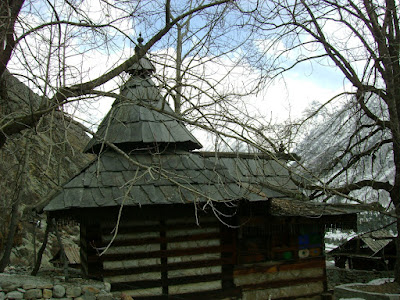
An old temple in Chitkul village


A newly built monastery in Sangla village


Sunrise, Kinner Kailash range


Morning at Kalpa village


Kalpa also known for its beautiful temples


Kinner Kailash changes seven colors during the day.


An interior view of a Tibetan monastery