Monday, September 15, 2008

A Safari through 'the great silk route & 'old Hindustan Tibet road'.

A pictorial presentation of a safari into little Tibet.


Beas, flowing down with its glacial waters
weawing Shawl is the major industry in Kullu valley

Poplar and Cedar pine forest on the left bank of Beas river in Manali
Rahala waterfalls on the way to Rothang pass
A glacier on the right bank of Chandra river, on the way to Kunzum pass from Manali

'Chandertal' - the moon lake.


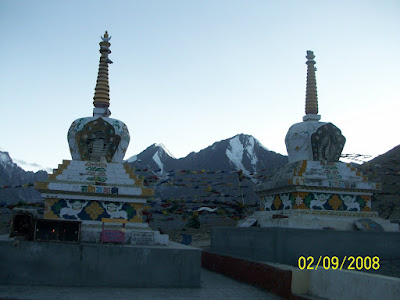
Upto Kunzum pass.

Kunzum pass. Elevation - 4551mts. from mean sea level.

Losar village - the first permanent settelment after Manali.

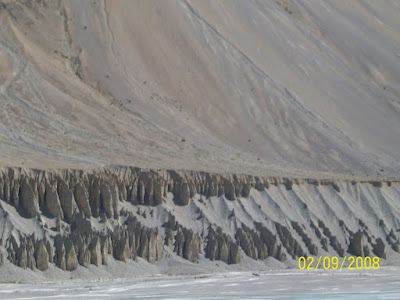
Dunes formed by glacial erosion


Approaching Kaza, the divisional headquarter of Spiti

A gorge at Kibber village

Kibber village

Traditional mud houses at kibber village

Fresh snow fall at Pin valley


A diverse alpine flora can be seen in Pin valley


A ropeway is the common way of getting to the other side of Pin river

Kungri monastery in Pin valley

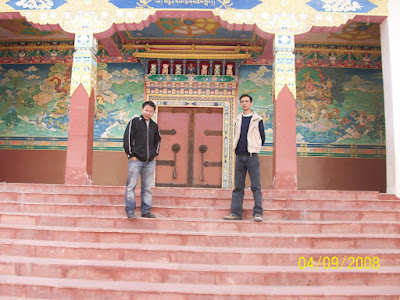
Its me on the right and my friend Jacob at Kungri monastery

A lamp being lit up by using yak butter

Leaving Pin valley

Top floor of Dhankar monastery

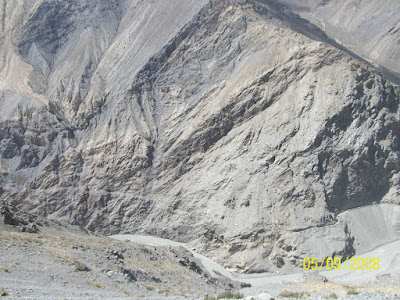
A gorge on the way to Nako village


Sumdo, police check post


Maling gorge

Nako village, with fresh snow covered Himalayas in the background


A life in safe hands..........

A traditional house at Nako village

A drive down to Khab

Khab, the confluence of Satluej and Spiti river

A valley bridge being built at Spello

Goddess Bhima Kali temple at Sarahan

Palace of Maharaja of Bushair Province


Sarasawati, the goddess of knowledge

Enterance of the Bhima Kali temple and end of our tour


Wednesday, August 6, 2008

Notable Peaks of the Himalayan System

Notable Peaks of the Himalayan System (includes outlying ranges)


Peak name: Eevrest

Other names and meaning: Sagarmatha, "Forehead of the Sky", Chomolangma, "Mother of the Universe"

Elevation (m): 8,848

Elevation (ft): 29,035

First ascent: 1953

Notes: World's highest mountain, situated in Nepal.

_________________________________________________________________________________

Peak name: K2
Other name and meaning: Chogo Gangri
Elevation(m): 8,611
Elevation(ft): 28,251
First ascent: 1954
Notes: World's 2nd highest. Located Located in the Karakoram Karakoram of Pakistan/ China.
__________________________________________________________________________________

Peak name: Kangchenjunga

Other name and meaning: Kangchen Dzö-nga, "Five Treasures of the Great Snow"

Elevation (m): 8,586

Elevation(ft): 28,169

First ascent: 1955

Notes: World's 3rd highest. Located in Sikkim (India) and Nepal.

_______________________________________________________________________________________


Peak name: Lhotse

Other name and meaning: "South Peak"

Elevation (m): 8,516

Elevation(ft): 27,940

First ascent: 1956

Notes: World's 4th highest. Situated between Nepal & Tibet, in the shadow of Everest.

_____________________________________________________________________________________

Peak name: Makalu

Other names and meaning: "The Great Black"

Elevation (m): 8,462

Elevation (ft): 27,765

First ascent: 1955

Notes: World's 5th highest. Situated in Nepal.

_____________________________________________________________________________________


Peak name: Cho Oyu

Other name and meaning: Qowowuyag, "Turquoise Goddess"

Elevation (m): 8,201

Elevation(ft): 26,905

First ascent: 1954

Notes: World's 6th highest. Situated in Nepal.

_____________________________________________________________________________________

Peak name: Dhaulagiri

Other names and meaning: "White Mountain"

Elevation(m): 8,167

Elevation(ft): 26,764

First ascent: 1960

Notes: World's 7th highest. Situated in Nepal.

_____________________________________________________________________________________


Peak name: Manaslu
Other names and meaning: Kutang, "Mountain of the Spirit"
Elevation(m): 8,156
Elevation(ft): 26,758
First ascent: 1956
Notes: World's 8th highest. Located in the Gurkha Himal, Nepal.

_____________________________________________________________________________________

Peak name: Nanga Parbat
Other names and : Diamir, "Naked Mountain"
Elevation(m): 8,126
Elevation(ft): 26,660
First ascent: 1953
Notes: World's 9th highest . Located in Pakistan.


___________________________________________________________________________

Peak name: Annapurna
Other names and meaning: "Goddess of the Harvests"
Elevation(m): 8,091
Elevation(ft): 26,545
First ascent: 1950
Notes: World's 10th highest. Deadliest mountain on Earth. Situated in Nepal.
_____________________________________________________________________________________


Tuesday, July 8, 2008

Himachal Himalayas


District Kullu


At the very heart of Himachal is Kullu, the chosen valley of the gods, and quite simply amongst the most beautiful places on earth. Here one is actually amidst the bewitching vistas that were only distantly visible from the hill stations.

One of the most ancient hill states, Kullu is referred to in the Vishnupurana, the Ramayana, and the Mahabharata by its original name – Kuluta. In traditional folklore it is termed as Kulantapith, ‘the end of the habitable world’. According to local belief it also represents the beginning of the human race. Manali is said to be a coinage of Manu-alaya –‘the home of Manu’, the survivor of the great deluge who first stepped off his celestial boat onto this chosen land.

Many mortals have followed suit to build the home of their dreams, some of these are now part of legacy of the valley. Among the earliest in 20th century to give up his native roots was a Russian painter, Nicholas Roerich, who settled in Naggar to spend a lifetime capturing the many moods of the landscape on his canvasses. A gallery at the Nagar Castle now preserves his work. Over the years there have been painters and poets, sadhus and mountaineers, and more recently, a growing tribe of flower-children who frequent the tea shop in Parbati valley, where the predominant crop is that of Cannabis.

Perhaps the most attractive feature of Kullu is the sense of well-being and amiability radiated by its inhabitants. Having led a life of plenty for generations, the people have a deep sense of belonging, which is reflected in their friendly manner and unassuming lifestyle. The man wears distinctive Kullu topis with their colorful flaps, and the women rap themselves in beautiful woven pattoos of homespun wool, secured with large silver brooches. The fabrics, especially the Kullu shawls, are much sought after by tourists, and have become a basis of a major cottage industry.

Upstream of Kullu is Manali, the star attraction of the district. Straddling the sparkling Beas, the little town has a flavor unlike that of a major hill stations, with its many splendid attractions and four-day treks. The Dhungri Temple, dedicated to Hidimba Devi, the wife of the Pandava Bhim, is the most important religious and architectural feature. Located in the tranquil setting amidst towering deodar trees, the 16th century old temple is four tiered, with a pagoda shaped roofs, and the doorway carved with mythological figures and symbols. Three kilometers (two miles) away are the hot sulphur springs at Vashisht, now turned into Turkish baths. Longer excursion of interests is the drive to Rothang pass or trek to Bhrigu tal, Beaskund and Chandrakhani Pass.
Manali also hosts the winter carnival, in which the best skiers of the country participate. This annual event is organized by Western Himalayan Mountaineering Institute, which provide training for basic and advanced climbing and other adventure sports.