
Chandra-Bhaga range from Rothangpass Kullu.
Borrowed from the immense natural beauty of deep valleys and mighty Himalayas, Himachal Pradesh obtains its name from the combination of two Hindi words, Him and Achal, whereas the former means snow and the later one stands for immovable.
The northern tribal districts of Himachal are Kinnaur, Lahual and Spiti respectively. Being very close to the border of Tibet these regions have a strong Buddhist influence and for the same reason sometimes also known as little Tibet. Being a mountain guide I have been associated with these areas for some years. This gave me opportunities to explore these Himalayan country sides clubbed with small settlements and ancient monasteries.
Located, in the great Himalayan range of the Himalayan mountain system, Spiti is also known as lunar landscape. With snow-clad mountains towering more than 6000 meters and almost no rains for the whole year, Spiti is also described as a cold desert because of the extension of Tibetan plateau towards this side.
Sharing international border with Tibet, Himachal have been an important trade route in the past. The famous Hidustan-Tibet road completed in 1856, from Shimla to the border of Tibet in Kinnaur valley attracted rest of the world. Explored and exploited for long, these Himalayan country sides however preserved their rich culture and traditions from centuries.
Open to the rest of world, for just 6-7 months district of Kinnaur and Spiti presents a contrast between lush green valleys and cold desert respectively. Chilgoza pines, silver fir, Junipers and birch trees grow well in Kinnaur valley which also the end of tree line. District Spiti, with a vast and cold desert and a diverse species of wild flowers and medicinal herbs demarks the clod desert of Himalayas. Majority of this flora has been used and narrated in Ayurveda, the ancient Hindu medicinal doctrine.
For an avid adventure and nature lover there is lot to explore and experience. The safari or trekking options recommended by professionals, should start with acclimatization for about 3-4 days before we start off on some serious walks, multi-days trekking options and even a safari where you attain an altitude of 3000 meters and plus. Here Shimla becomes a perfect base and host for this great Himalayan journey.
A tour or a trek to Kinnaur and Spiti valleys takes about two weeks before entering the lush green Kullu valley over Rothang Pass. A drive from Shimla, through small villages of Sarahan, Sangla, Chitkul, Kalpa and Nako, with centuries old monasteries at Tabo, Dhankar and Ki would complete this circuit. Out of two national parks in the state, Pin valley national park is in the district of Spiti and before driving over the famous Kunzum pass the journey is incomplete without a drive or a night stay at Kibber village, known for its village at the altitude at the elevation of 4,200 meters.
Pin valley, in Spiti is a Himalayan national park, about 80736.00 hectares, adoring virgin peaks towering more than 6,000 meters. Whereas rivers down in the deep valleys pouring the glacial deposits into the Arabian Sea. Housing a wide variety of rare Himalayan flora and fauna Pin valley national park hosts woolly hare, red fox, Himalayan ibex, marmot, Tibetan gazelle, Himalayan porcupine, blue sheep, Tibetan wolf and snow leopard. Only few trees like Betula utilis (Bhoj patra) and Juniperus macropoda (Bhutal) can adapt to the hostile winters of Himalayas. It also demarks the end of the tree line giving way to the Himalayan alpine meadows. Also plants and flowers like Agropyron spp., Anemone obteusiloba, Artemisia spp., Canibs Sativa, Crataegus oxycantha thrive well for just 4-5 months in summers.


 Beas, flowing down with its glacial waters
 weawing Shawl is the major industry in Kullu valley
 Poplar and Cedar pine forest on the left bank of Beas river in Manali
 Rahala waterfalls on the way to Rothang pass
 A glacier on the right bank of Chandra river, on the way to Kunzum pass from Manali
 'Chandertal' - the moon lake.
 Upto Kunzum pass.
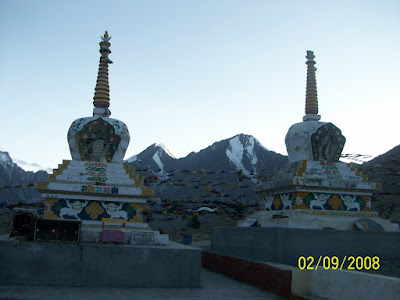 Kunzum pass. Elevation - 4551mts. from mean sea level.
 Losar village - the first permanent settelment after Manali.
 Dunes formed by glacial erosion
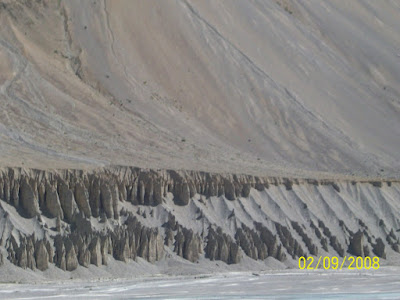
 Approaching Kaza, the divisional headquarter of Spiti
 A gorge at Kibber village
 Kibber village
 Traditional mud houses at kibber village
 Fresh snow fall at Pin valley

 A diverse alpine flora can be seen in Pin valley

 A ropeway is the common way of getting to the other side of Pin river
 Kungri monastery in Pin valley
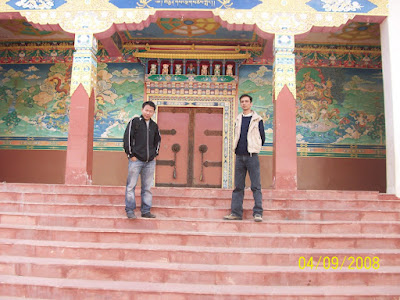 Its me on the right and my friend Jacob at Kungri monastery

 A lamp being lit up by using yak butter
 Leaving Pin valley
 Top floor of Dhankar monastery
 A gorge on the way to Nako village

 Sumdo, police check post

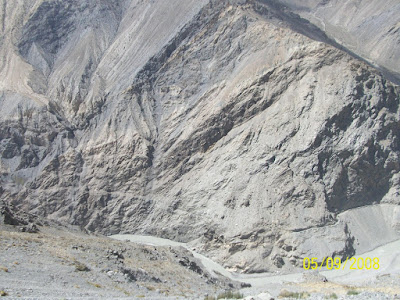
 Maling gorge
 Nako village, with fresh snow covered Himalayas in the background


 A life in safe hands..........
 A traditional house at Nako village
 A drive down to Khab
 Khab, the confluence of Satluej and Spiti river
 A valley bridge being built at Spello
 Goddess Bhima Kali temple at Sarahan
 Palace of Maharaja of Bushair Province


 Sarasawati, the goddess of knowledge
 Enterance of the Bhima Kali temple and end of our tour


 Peak name: Makalu

 Peak name: Dhaulagiri
 Peak name: Manaslu
 Peak name: Nanga Parbat


